Cardiopulmonary Exercise Testing · Abu Dhabi
VO₂max — the ceiling of your aerobic life
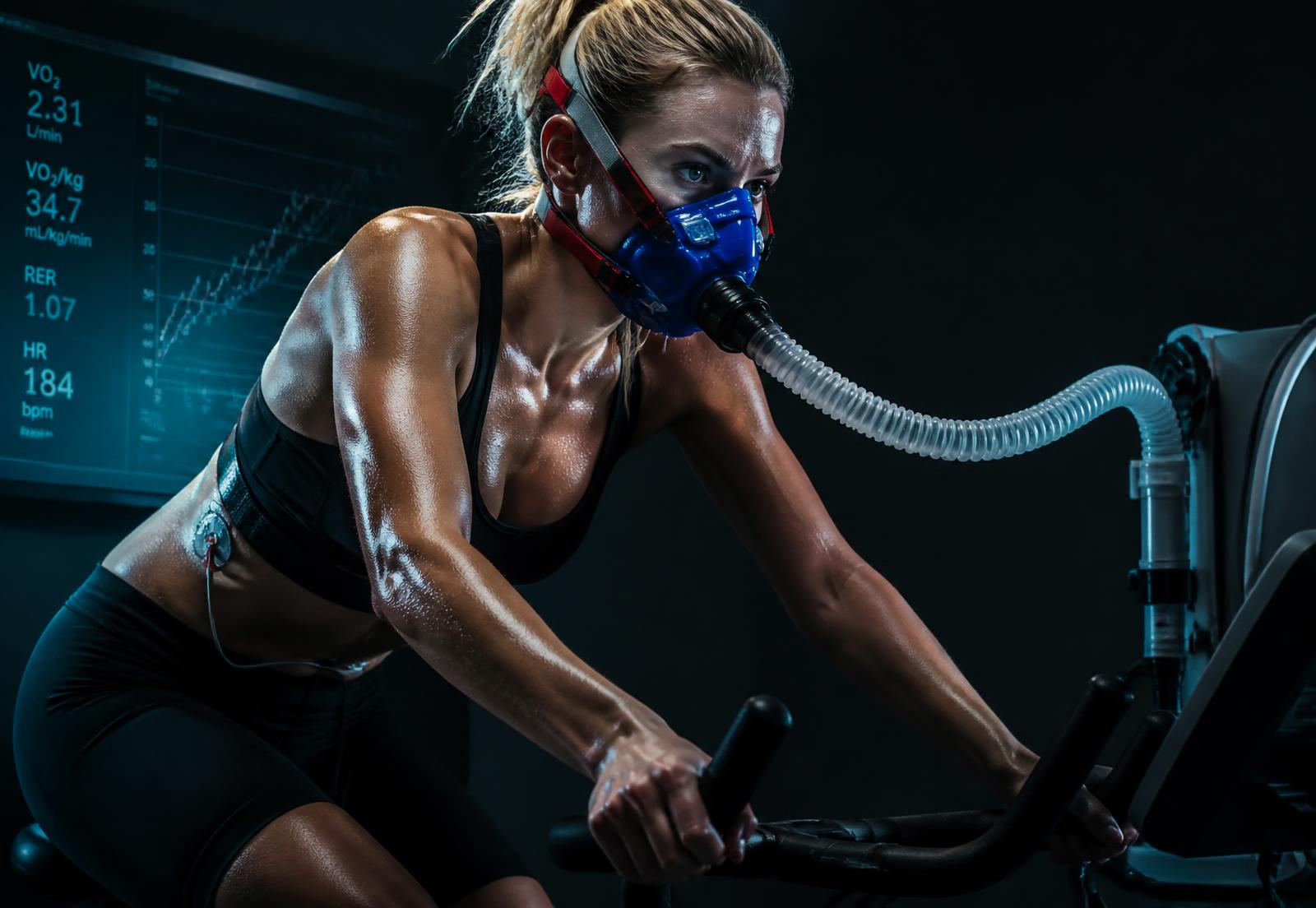
Breath-by-breath gas exchange analysis measures exactly how much oxygen your body can transport and consume under load. Not an estimate from a watch — a laboratory value, expressed in millilitres of oxygen per kilogram per minute.
What VO₂max
actually measures
VO₂max is the maximal rate of oxygen uptake, described by the Fick equation: VO₂ = cardiac output × arteriovenous oxygen difference. It is the product of central delivery — heart rate, stroke volume, haemoglobin, pulmonary diffusion — and peripheral extraction by mitochondria in working muscle.
Expressed relative to body mass (ml·kg⁻¹·min⁻¹), it defines your aerobic ceiling: the intensity above which no steady state exists. Every submaximal effort you perform — a flight of stairs, a threshold interval, a full day on your feet — is a percentage of that ceiling.
Cardiorespiratory fitness is an independent, graded predictor of all-cause and cardiovascular mortality. Each 1 MET (≈3.5 ml·kg⁻¹·min⁻¹) improvement is associated with a meaningful reduction in mortality risk.
What we capture
Maximal oxygen uptake
The ceiling of aerobic metabolism — the strongest single predictor of all-cause mortality.
Aerobic & anaerobic threshold
The two inflection points that define where each training zone truly begins and ends.
Respiratory exchange ratio
Substrate utilisation: how efficiently you oxidise fat versus carbohydrate at every intensity.
Stroke volume surrogate
Oxygen delivered per heartbeat — a direct window into cardiac output and central limitation.
Sixty minutes,
five stages
- 01
Pre-test screening
Health history, resting HR and blood pressure, contraindication screening per ACSM guidelines, body composition and resting metabolic rate (RMR) if indicated.
- 02
Instrumentation
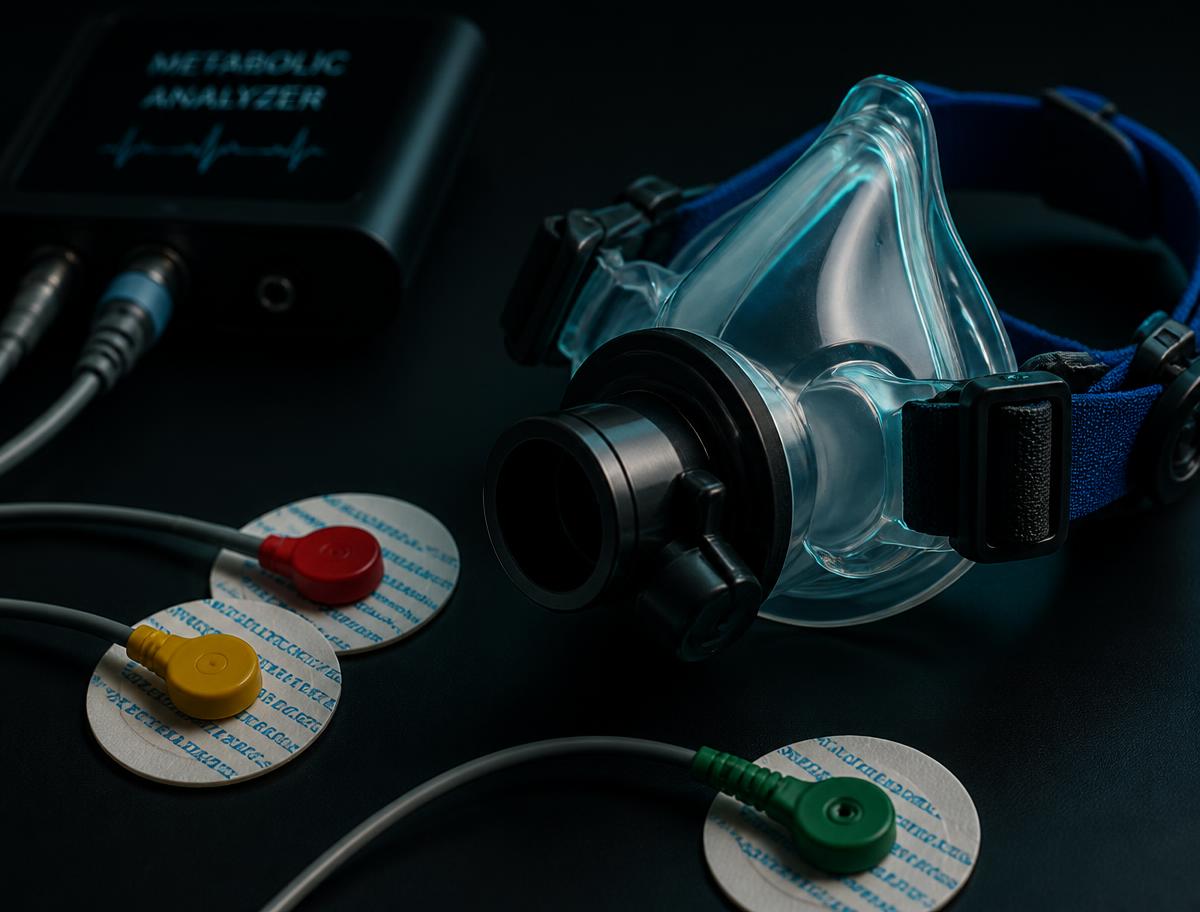
Calibrated metabolic cart, silicone face mask with flow turbine, chest-strap ECG/heart-rate telemetry, and RPE scale familiarisation on cycle ergometer or treadmill.
- 03
Incremental ramp to volitional exhaustion
A ramp or graded protocol (typically 8–12 minutes) with breath-by-breath gas exchange sampling until a VO₂ plateau, RER > 1.10 and maximal effort criteria are met.
- 04
Active recovery & HRR
Monitored cool-down with heart-rate recovery (HRR₁ min) captured — an independent marker of autonomic function and cardiovascular risk.
- 05
Report & prescription
Debrief of your full cardiopulmonary profile, percentile ranking against age- and sex-matched norms, and an individualised zone-based training prescription.
Training zones anchored to your thresholds, not a formula
Age-predicted maximum heart rate carries an error of roughly ±12 bpm. Measured ventilatory thresholds do not. Every zone below is drawn from your own gas-exchange curve.
Who it is for
Longevity clients
Cardiorespiratory fitness is a stronger predictor of survival than smoking, hypertension or diabetes. Moving from the bottom quartile to above average is the single largest modifiable gain in healthspan.
Endurance athletes
Precise VT1/VT2 anchors replace guesswork percentages of max HR, so polarised or threshold blocks are built on your physiology, not a formula.
Post-rehabilitation & desk-bound
Low O₂ pulse, early VT1 or blunted heart-rate recovery flag central limitation long before symptoms appear — and respond quickly to structured aerobic work.
Before you test
- Is VO₂max testing maximal or submaximal?
- We perform a true maximal cardiopulmonary exercise test (CPET). Validity criteria include a plateau in oxygen uptake despite rising workload, RER above 1.10, heart rate within 10 bpm of age-predicted maximum and an RPE of 19–20. Submaximal estimation is available where a maximal effort is contraindicated.
- How should I prepare?
- Avoid vigorous training for 24 hours, caffeine for 6 hours, and food for 3 hours before the test. Arrive hydrated, in training kit, with any regular medication taken as prescribed.
- How long does the appointment take?
- Around 60 minutes in total: 15 minutes of screening and instrumentation, 8–12 minutes of incremental exercise, cool-down, then a full debrief of your results and training prescription.
- How often should I retest?
- Every 10–12 weeks. That is the window in which mitochondrial density, stroke volume and threshold shifts become measurable in response to a structured programme.